What SYSTEM Stands For
Many business owners reach a point of stability only to realize they have accidentally built a job for themselves rather than a scalable enterprise. They want more free time and higher efficiency, but their business relies entirely on their personal presence to function.
The only way out of this trap is systemization. While it can feel like a massive undertaking, it is entirely achievable when broken down into small, deliberate steps. The ultimate goal of an acronym-driven business is simple.
A true SYSTEM is designed to:Save Yourself Time, Energy, and Money.
The 4 Pillars of Business Systemization
Before writing standard operating procedures, you must understand the four distinct quadrants where systems must be introduced in your organization:
People & Education: This governs your human capital. It defines how you recruit, hire, onboard, train, develop, and manage your team members so they can execute at a high level without your constant supervision.
Delivery & Distribution: This is your fulfillment engine. It outlines exactly how your business executes, packages, and provides its products and services to the customer, ensuring a consistent, "wow" experience every single time.
Testing & Measuring: This introduces data-driven analytics and experimentation. By focusing on KPIs and tracking your daily metrics, you can find better ways to execute and measure your operational results along the way.
Systems & Technology: This is your leverage point. It involves deploying software, hardware, and automated tools that execute tasks flawlessly and repeatedly with minimal manual effort.
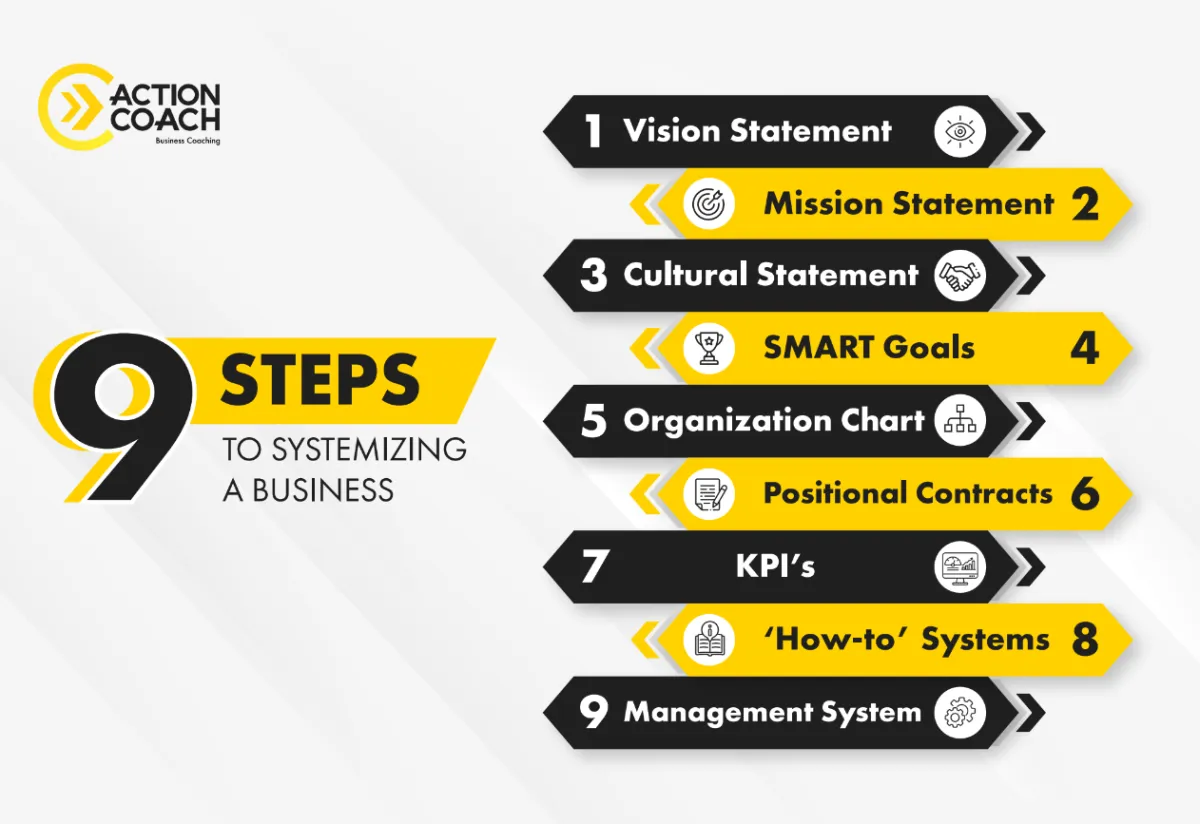
The 9 Steps to Building Systems
Systemization follows a logical hierarchy. You cannot build a daily tracking sheet if your team doesn't know what the company's ultimate goal is. To build an ironclad foundation, follow these 9 steps:
Vision Statement: Where your company is going in the long term.
Mission Statement: The roadmap of how you will achieve that vision daily.
Defined Values and Culture: The behavioral rules and identity of your organization.
SMART Goals: Specific, Measurable, Achievable, Results-oriented, and Time-bound targets.
Organization Chart: The structure of accountability and future growth design.
Job Descriptions: Clear definitions of roles, outcomes, and responsibilities.
KPIs (Key Performance Indicators): The metrics used to measure individual and team success.
The "How To" Systems and Documents: The written standard operating procedures (SOPs) for daily tasks.
The Management System: The meeting structures and reporting cadences that keep everything aligned.
By addressing these steps incrementally, a potentially massive project becomes a series of predictable, high-impact wins for your company.
Is your business structured to run without you?
Let's schedule a short call and dig in to find your best opportunities. Schedule a 20 Minute Call
